Trailmaster Field Bowie Survival Knife - Black Blade Leather
13 sold in last 24 hours
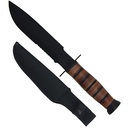
This is a fixed blade built for real trail work, not glass cases. A 7" matte black clip-point Bowie profile gives you reach, bite, and control, while the partial serrations chew through cord, bark, and stubborn material. Full tang construction runs through the stacked leather handle, giving that classic, confident grip that doesn’t quit when your hands are wet, cold, or dirty. Riding in a nylon belt sheath, it’s exactly what you want on your hip when camp chores turn into real survival tasks.
Trailmaster Field Bowie Survival Knife - Built for Real Wilderness Work
Some knives are bought to be admired. This one is bought to be used. The Trailmaster Field Bowie Survival Knife - Black Blade Leather is a classic fixed blade designed for exactly what its name suggests: real trail work, camp chores, and the kind of backcountry use that exposes weak steel and bad ergonomics in the first hour.
You’re looking at a 12" overall knife with a 7" matte black clip-point blade, partial serrations, full tang, and a stacked leather handle that feels like the service knives that actually saw field time. This is not an automatic knife, not an OTF, not a switchblade showpiece — it’s a straightforward, full-tang field Bowie that earns its place on your belt the old-fashioned way: performance.
Why This Fixed Blade Earns a Spot Next to Your Automatic Knives
Even if your drawer is full of automatic knives for sale, there are jobs where a fixed blade is the only correct answer. No springs, no pivot, no lock to fail — just a single piece of steel running the length of the handle, ready to pry, baton, carve, and take real lateral stress.
The 7" clip point gives you that familiar Bowie geometry: plenty of straight edge for controlled cuts, a fine tip for detail work, and a long, flowing belly for slicing. Where this design gets interesting is the combination of a matte black coated blade and partial serrations near the handle, giving you two cutting personalities on the same piece of steel.
Partial Serrations Where They Actually Make Sense
Serrations belong near the handle, not out near the tip where you lose leverage. Here, the serrated section sits right where your hand naturally generates the most power. That makes short work of rope, webbing, green branches, and the tough, fibrous material that smooth edges skate across. The rest of the edge stays clean and controllable for food prep, feather sticks, and fine carving.
Full Tang Backbone with Real-World Confidence
Full tang on this knife isn’t a marketing bullet — it’s the backbone of the design. The steel runs all the way through the stacked leather handle to the rounded pommel, which means you can baton through wood, lever, and twist without wondering if a hidden rat-tail tang is going to give up on you. In a survival or extended camp scenario, that kind of structural honesty matters more than any clever deployment mechanism.
Handle, Balance, and the Classic Stacked Leather Feel
The stacked leather handle is where this knife stops being generic and starts feeling like a deliberate nod to classic military field knives. Leather rings compressed along the tang create a warm, organic grip that conforms as it wears in, not out. In cold weather, leather doesn’t punish your hand like bare metal. Wet conditions? The subtle ridging and give of leather keep you locked in without resorting to aggressive, pocket-chewing texture.
Balance on a 12" knife this size matters. The guard, tang, and leather stack pull the center of gravity back toward the hand, so it doesn’t feel like you’re swinging a crowbar. That translates into more control when you choke up for carving or detail work, and less fatigue when you’re breaking down kindling or processing camp tasks for an hour straight.
Carry Reality: Belt-Ready, Trail-Ready
A field knife that rides in the pack instead of on the belt doesn’t see much work. The included black nylon sheath is built for exactly what this knife is: a working Bowie. Belt loop carry, snap retention strap over the guard, and a slim profile that doesn’t swing wildly when you’re moving through brush. It’s not ornamental leather; it’s functional nylon that shrugs off rain, sweat, and dirt.
If your usual rotation is an automatic knife for EDC and a compact folder for backup, this fixed blade fills the gap as your dedicated trail and camp tool. When you’re processing wood, prepping camp stakes, or doing real bush chores, you’ll reach for this before you ever touch a spring-loaded folder.
Steel, Edge, and What You Can Expect in the Field
The blade steel is a workhorse, coated in matte black to add corrosion resistance and reduce glare. Is this a boutique powder metallurgy steel? No. It’s the kind of straightforward, tough steel that takes a working edge, sharpens easily with basic field stones, and doesn’t chip out the moment you touch knotty wood or dirty rope. For a knife meant to live hard on a belt, that tradeoff — toughness and easy maintenance over lab-spec edge retention — is exactly right.
For the enthusiast who collects automatic knives and OTFs, this fixed blade offers a different kind of satisfaction: a piece of steel you don’t baby. You don’t worry about pocket lint in the mechanism or grit in a track. You beat on it, wipe it down, and it’s ready for the next outing.
Legal Context: Why Fixed Blades Stay Simple Where Automatics Get Complicated
If you’re used to checking every state’s stance before you buy automatic knives for sale, you’ll appreciate how refreshingly straightforward a fixed blade like this can be. In the United States, federal law takes a specific interest in automatic knives and switchblades, especially in the context of interstate commerce and import. Fixed blades, by contrast, are generally regulated — if at all — at the state and local level based on blade length, concealment, and location (schools, government buildings, etc.).
Translation: where your double action automatic knife might be a gray area, this full-size field Bowie is often legal so long as you comply with local length and carry rules, especially regarding open vs. concealed carry. Always verify your state and city laws before strapping it on as an EDC or vehicle carry tool, but know that you’re not fighting the same federal switchblade framework that governs many automatic mechanisms.
What Buyers Ask Before Purchasing an Automatic Knife
Are automatic knives legal?
In the U.S., automatic knife legality is a two-layer issue. Federally, the Switchblade Act regulates manufacturing, interstate shipping, and import of automatic knives and traditional switchblades, but it doesn’t directly govern simple ownership by individuals. The real complexity comes from state and local laws: some states fully allow automatic knives, some restrict blade length, some limit carry (especially concealed carry), and a few still ban them outright for non-law enforcement users.
Fixed blades like this Trailmaster field Bowie are usually treated under a different set of rules that focus on length, concealment, and location. If you already collect automatics or OTF knives, you know the drill: always check your state and municipal regulations before you buy, carry, or travel with any automatic, OTF, or large fixed blade.
What’s the difference between an automatic knife, OTF, and a switchblade?
“Automatic knife” is the broad mechanical category: a blade that deploys from a closed position by pressing a button, lever, or similar control, using an internal spring or stored energy. A traditional side-opening switchblade is a specific style of automatic knife where the blade swings out from the side like a folder, driven by that spring. An OTF (out-the-front) knife is another subset of automatic knives where the blade deploys straight out of the handle’s front slot.
This Trailmaster isn’t any of those — it’s a fixed blade Bowie. No pivot, no spring, no deployment mechanism. It’s always open, which makes it mechanically simpler and generally less legally sensitive than automatic knives and classic switchblades, while still complementing them in a serious collection.
What makes this automatic knife worth buying?
Applied correctly to this piece: what makes this fixed blade worth buying is the intersection of classic field-proven design and honest, hard-use construction. You’re getting a full-tang, 7" Bowie-profile blade with practical partial serrations, a stacked leather grip that actually feels better the more you use it, and a belt-ready nylon sheath that encourages carry instead of drawer duty.
For a collector of automatic knives and OTFs, this is the knife you take when you stop talking about deployment speed and start talking about batoning, carving, and camp survival. It doesn’t replace your automatics; it fills the gap they’re not built to handle.
For the Enthusiast Who Chooses Tools on Purpose
If you’re the kind of buyer who knows why you’d pick an automatic knife for fast one-handed deployment and a fixed blade Bowie for serious field work, this Trailmaster Field Bowie Survival Knife - Black Blade Leather fits your mindset. It’s not chasing trends or gimmicks — it’s a straightforward, mechanically honest tool.
Add it alongside your favorite automatic knives for sale, not as competition, but as the piece you reach for when the trail gets long, the light gets low, and you want a blade that doesn’t need a button to prove it belongs there.
| Blade Length (inches) | 7 |
| Overall Length (inches) | 12 |
| Blade Color | Black |
| Blade Finish | Matte |
| Blade Style | Clip Point |
| Blade Edge | Partial-Serrated |
| Blade Material | Steel |
| Handle Finish | Matte |
| Handle Material | Leather |
| Theme | Bowie |
| Handle Length (inches) | 5 |
| Tang Type | Full tang |
| Pommel/Butt Cap | Rounded pommel |
| Carry Method | Belt carry |
| Sheath/Holster | Nylon sheath |