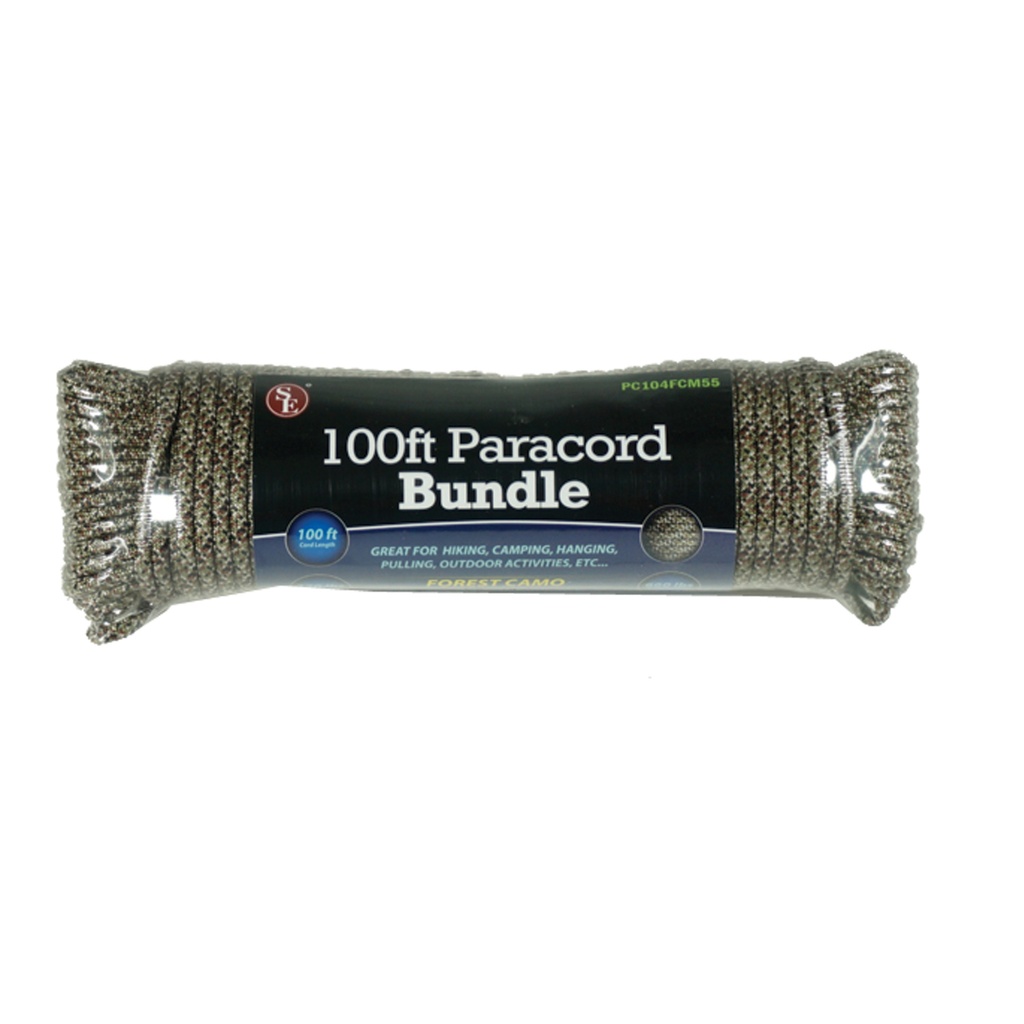
Treeline Concealment Field-Ready Survival Paracord - Forest Camo
5 sold in last 24 hours
Serious automatic knife carriers know the rest of the kit matters. This 550 survival paracord rides backup to your edge: 7‑strand core, true working 550 rating, and a forest camo weave that disappears into the treeline instead of screaming orange from fifty yards out. At 100 feet, it’s enough to rig a proper camp, hang a bear bag, lash a shelter, or improvise a sling when things go sideways. No gimmicks—just dependable cordage that behaves when you need it.
Why Serious Knife Carriers Still Respect a Good 550 Cord
If you’re the kind of buyer who actually cares what steel your automatic rides in, you already know the blade isn’t the whole kit. The knife handles the cutting. The cord handles everything else. Treeline Concealment Field-Ready 550 Survival Paracord in Forest Camo is the quiet workhorse that sits behind your automatic knife and makes the rest of the job possible—rigging shelter, suspending gear, tensioning tarps, and solving the ugly problems that don’t make it into Instagram shots.
This isn’t decorative craft cord. It’s true 550 paracord: a 7‑strand core inside a tight nylon sheath, rated to handle real loads and real improvisation when the plan falls apart in the rain at dusk.
Survival Paracord Built for Real-World Field Use
When you buy cordage to live in the same pack as your automatic knife, you don’t want mystery specs. This 100 ft bundle of 550 survival paracord is spec’d for actual field work:
- 550 rating: Built to the classic 550 standard—strong enough for serious lashing, ridgelines, and hauling without pretending to be climbing rope.
- Seven internal core strands: Each inner strand can be pulled and used independently for sewing repairs, finer lashings, or gear fixes where full-diameter cord is overkill.
- Tight, consistent sheath weave: A cleaner weave means less snagging through hardware, smoother knots, and better abrasion resistance when it’s rubbing against bark, rock, or metal.
- 100 ft working length: Enough cord to build a legitimate camp setup, split into multiple lines, without turning your pack into a tangled shrine to over-preparedness.
It’s the difference between cord you trust and cord you babysit. One earns a permanent spot next to your automatic knife; the other lives in a junk drawer. This belongs in the first category.
Forest Camo That Actually Belongs in the Treeline
Design on cordage should serve function first. The forest camo pattern on this paracord isn’t cosmetic—it's tuned to disappear in mixed timber, underbrush, and wet ground. Greens, browns, and tans are balanced so the line breaks up visually instead of reading as a single bright stripe against bark or leaf litter.
Why does that matter? Because if you run an automatic knife with a low‑vis carry setup, you don’t want your cordage screaming for attention. Forest camo keeps your camp clean and your profile quiet, whether you’re lashing gear on a pack frame, running a ridgeline between trees, or setting up a hide in the woods.
Deployment and Handling in the Field
Good cord, like a good automatic action, is all about predictable deployment. This 550 survival paracord is bundled for clean payout: no ridiculous factory knots, no gimmick spools that explode in your pack. Pull what you need, cut with your auto, tie in, and move on.
The sheath’s texture hits the sweet spot—slick enough to glide through glove leather and tarp grommets, grippy enough for secure knots that cinch down and stay put. Wet, cold, or dirty, it still bites properly when you dress the knot. That’s the cordage equivalent of a reliable double-action deployment: you don’t have to think about it; you just use it.
Seven-Strand Core: The Hidden System Inside
Collectors obsess over lock geometry and detent tuning on an automatic knife; cord nerds look just as hard at what’s inside the sheath. The seven-strand core isn’t marketing fluff. Those inner strands are your small-problem toolkit:
- Strip a strand to stitch torn webbing or pack straps.
- Use individual cores for snares, traps, or light-duty tie-downs.
- Build finer guy lines without wasting full-diameter cord.
It’s modular capability. One 100 ft length of survival paracord becomes multiple tools once you start pulling cores and reassigning duties. That’s the same mindset that leads you to carry one well-tuned automatic knife instead of three mediocre folders.
Pairing Your Automatic Knife with Proper Survival Cordage
Automatic knives are at their best when they’re backed by the right support gear. This 550 paracord turns your automatic into more than just a cutting tool—it becomes the centerpiece of an adaptable field system. Cut clean sections for shelter lines, tensioning straps, and improvised harnesses. Use your auto’s fast deployment to strip outer sheath and access core strands in seconds.
There’s a reason seasoned outdoorsmen and serious EDC carriers treat cordage like a baseline, not an afterthought. The knife solves "how do I separate this?" The cord solves "how do I hold this together?" Every good camp build, emergency splint, or last-minute gear fix is that simple equation.
What Buyers Ask Before Purchasing an Automatic Knife
Are automatic knives legal?
In the U.S., automatic knives sit under a mix of federal and state rules. Federally, the Switchblade Knife Act restricts interstate commerce and mailing of automatic knives and classic switchblades, with some exceptions for military, law enforcement, and certain uses. That federal law doesn’t outright ban owning an automatic knife, but it does limit how and where they can be shipped and sold across state lines.
Real-world legality comes down to your state and sometimes your city. Some states now allow automatic knives for everyday carry with blade length limits or permit rules; others still ban possession entirely or restrict carry to law enforcement or active duty military. Before you buy an automatic knife for EDC or collection, you need to check your current local laws—state statutes and any county or municipal ordinances. Laws change, and what’s legal in one state can still be a problem across a border. The survival paracord here is legal kit anywhere; your automatic knife may not be. Know the difference and buy accordingly.
What’s the difference between an automatic knife, OTF, and a switchblade?
Mechanically, these terms get thrown around sloppily in marketing, but they mean specific things:
- Automatic knife: The broad category—press a button, push a hidden release, or actuate a lever, and spring tension drives the blade open. Most side-opening autos fall here.
- OTF (Out-The-Front) knife: A subtype of automatic where the blade travels linearly out the front of the handle instead of pivoting out of the side. Many OTFs are double-action—same control both deploys and retracts the blade.
- Switchblade: In common use, it’s a side-opening automatic knife with a button-actuated spring. Legally, many jurisdictions use "switchblade" as the term covering automatic mechanisms in general.
All OTF knives are automatic, but not all automatic knives are OTF. What doesn’t belong in this group is spring-assisted: assisted-opening knives require you to start moving the blade manually before a torsion bar or spring helps it the rest of the way. That distinction matters in law and in performance discussions.
What makes this automatic knife worth buying?
When you’re evaluating an automatic knife, you’re looking for three things: a clean, decisive deployment; steel that justifies regular use; and construction that doesn’t loosen or rattle after a month of carry. A good double-action OTF will show tight blade play, consistent firing strength, and a switch that feels positive, not mushy. A serious side-opening automatic will have secure lockup, minimal bounce on opening, and a button or actuator that’s crisp without being hair-trigger.
Pair that with blade steel that actually matches your use—sensible hardness, corrosion resistance for your climate, and geometry that cuts more than it poses—and you’ve got an automatic worth the pocket space. Then build out your kit with dependable survival paracord like this 550 Forest Camo, and you’ve moved from "cool knife" to a legitimately capable field setup.
Why This 550 Survival Paracord Belongs in a Serious Kit
If you already care enough to research the best automatic knife for EDC, you understand the value of small mechanical advantages. This 550 survival paracord lines up with that mindset: honest specs, no fluff, and performance that doesn’t need a hype man.
Seven-strand core, 100 ft of usable length, and a forest camo pattern that actually belongs in the woods—that’s the baseline. The real value is how it behaves with the blade you choose: it cuts clean, knots predictably, holds tension, and shrugs off the kind of abuse camp life throws at cord. That’s why you buy once, pack it next to your auto, and forget it until the moment you need it to perform.
In a market full of loud colors and louder claims, this paracord takes the same path as a well-made automatic knife for sale: engineered to work, not just to be photographed. If your gear standard is "no weak links," this belongs in your loadout.