Urban Grid Rapid-Access Tactical Backpack - Blue/Black
10 sold in last 24 hours
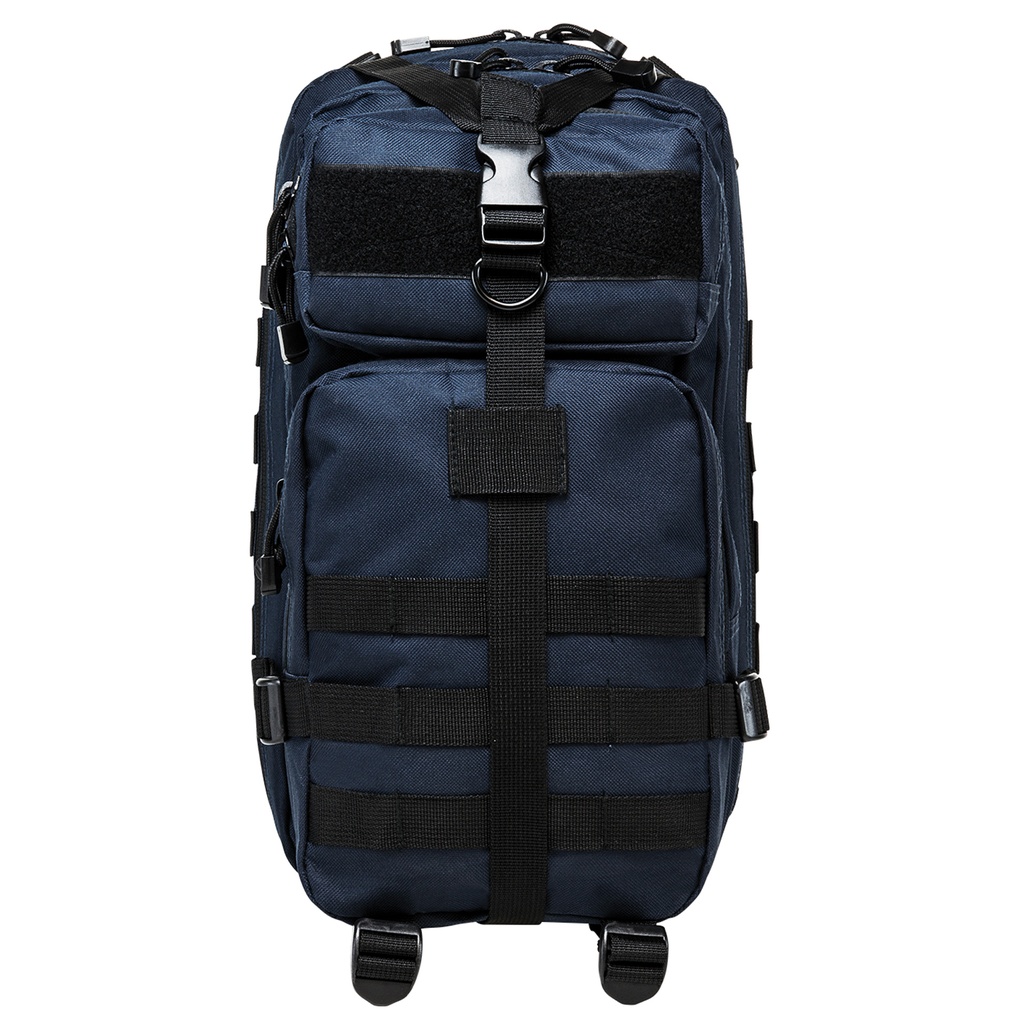
This isn’t a fashion backpack; it’s a compact tactical pack built for real EDC. The Urban Grid Rapid-Access Tactical Backpack – Blue/Black runs a structured 17 x 8.75 x 4.5 main compartment, full MOLLE real estate, and true load control with sternum strap, waist belt, and all-around compression. Rugged nylon, quick-snap buckles, and smart organizer pockets keep range gear, urban carry, or trail essentials locked down and exactly where you expect them—every time you grab the handle.
Urban Grid Rapid-Access Tactical Backpack - Blue/Black
The Urban Grid Rapid-Access Tactical Backpack - Blue/Black is built for people who treat their pack like a piece of equipment, not a fashion accessory. Compact, structured, and unapologetically tactical, it’s a true urban EDC pack that moves fast, carries tight, and stays stable whether you’re weaving through city streets, hitting the range, or covering a few hard trail miles after work.
Why This Compact Tactical Backpack Belongs in a Serious EDC Kit
Look at the silhouette first: short, boxy, and controlled. That 17 x 8.75 x 4.5 inch main compartment gives you enough volume for a real daily loadout—range kit, work essentials, med gear, or travel basics—without turning into a floppy, overbuilt rucksack. The structure matters. A compact tactical backpack only earns its keep if it keeps weight close to your spine, doesn’t sway, and doesn’t fight you when you move. This one does exactly that.
Heavy-duty zippers with dual pulls, full-length compression straps on every side, and a top grab handle you can actually trust bring it into proper gear territory. Add MOLLE webbing, a loop patch panel, and multiple attachment points, and you get an EDC platform you can tune to the way you actually carry.
Built Like Real Gear: Load Control, Not Just Capacity
Most backpacks brag about volume. Serious users care about how that volume behaves when it’s on their back. That’s where this pack earns respect.
Stabilized Carry: Sternum Strap, Waist Belt, and Compression
The Urban Grid runs a proper stability system: sternum strap, waist belt, and a full set of compression straps on every side. Cinch the side straps and you pull the load tight into a single block—no flop, no bounce, no swinging center of gravity when you move fast or change direction. Clip the sternum strap and waist belt, and the whole pack locks into your torso instead of hanging off your shoulders.
On the range, that stability keeps your draw and movement clean. On a trail or fast urban run, it keeps fatigue down and control up. For anyone used to tactical gear, this is the minimum standard—and this pack clears it.
MOLLE Grid and Purpose-Built Carry Points
Across the lower front pocket you’ve got horizontal MOLLE webbing ready for pouches, med kits, or tool rolls. The large loop panel on the upper pocket isn’t just for attitude patches—it’s real estate for ID, unit, or role-specific markers if you run this in a more professional context.
Bottom attachment loops and a centered vertical front strap with D-ring give you external lashing options for jackets, bedrolls, or odd-shaped gear. Multiple carry points mean you can stage carabiners, gloves, or range essentials exactly where muscle memory expects them.
Organization That Respects How EDC Actually Works
Inside, the design stays tactical and practical. Heavy-duty zippers open to smart organizer pockets that separate hard edges from soft goods and keep critical items from migrating to the bottom of the bag.
The main compartment’s 17 x 8.75 x 4.5 inches will swallow daily kits—IFAK, tool pouch, range logbook, compact electronics, extra mags, or a stripped-down overnight load. Front pockets handle admin and small gear so you’re not excavating the main compartment just to find a pen, flashlight, or cable.
This isn’t a cavernous, shapeless sack. It’s a compact tactical backpack tuned to the way people who carry gear every day actually move through a 24-hour cycle—commute, work, range, trail, repeat.
Rugged Nylon and Hardware You Don’t Have to Baby
The fabric is a durable, textured nylon chosen for abrasion resistance and weather resilience, not for looking pretty on a shelf. Paired with black webbing, it shrugs off urban abuse—train seats, truck beds, concrete, gravel—and keeps going.
Quick-snap buckles, side-release hardware on the compression straps, and reinforced stitching at load points make this feel like kit, not luggage. Dark navy blue body with black trim and hardware keeps the visual profile low-key: tactical DNA without screaming for attention.
What Buyers Ask Before Purchasing an Automatic Knife
Even though this is a compact tactical backpack, the people who buy it often run automatic knives, OTFs, and modern switchblades in their EDC. The questions they ask about legality, mechanisms, and real-world carry are the same ones that shape how they choose their supporting gear.
Are automatic knives legal?
Under U.S. federal law, automatic knives—whether side-opening automatics or OTF (out-the-front) autos—are regulated primarily by the Federal Switchblade Act. That act restricts interstate commerce in automatic knives but does not outright ban ownership at the federal level. The real deciding factor is state and sometimes local law.
Some states allow automatic knives and OTFs for general carry, some allow them with blade length limits or for specific roles (law enforcement, military, first responders), and others restrict or prohibit them entirely. Before you buy or carry any automatic knife, check the current statutes in your state and city, including how they define a “switchblade,” “automatic knife,” or “gravity knife.” Laws change; staying current is part of being a responsible owner.
What’s the difference between an automatic knife, OTF, and a switchblade?
In enthusiast terms, “automatic knife” is the broad category: a blade that opens via a spring or powered mechanism when you hit a button, toggle, or slide, with no need to assist the blade manually. A classic side-opening automatic swings the blade out from the handle on a pivot.
OTF—out-the-front—refers to an automatic knife whose blade deploys linearly through a slot in the front of the handle. A double-action OTF uses a single control to both deploy and retract the blade; a single-action OTF fires with the mechanism but must be manually reset.
“Switchblade” started as the colloquial and legal term used in older laws for many types of automatic knives, especially side-opening autos. Modern enthusiasts usually reserve “automatic” and “OTF” for mechanical clarity, but many statutes still use “switchblade” as the catch-all legal term. Mechanically, not every assisted-opening knife is an automatic; if you must start the blade manually and the spring only finishes the motion, that’s assisted, not automatic.
What makes this automatic knife worth buying?
If you’re pairing this backpack with an automatic knife, the same criteria apply to both: reliability, control, and purpose-built design. A good automatic knife is worth buying when its action is consistent, lockup is solid, the steel is chosen for your real-world use, and the ergonomics let you deploy and reholster without drama.
In the same way, this compact tactical backpack is worth owning because its structure, compression system, MOLLE layout, and stabilization straps all serve a clear purpose. It’s not "tactical" by paint job; it’s tactical by function. When your auto rides in this pack—clipped to an internal pocket, staged in a pouch on the MOLLE, or carried on your person—the pack isn’t the weak link in your setup.
EDC Identity: A Compact Tactical Backpack for People Who Take Their Gear Seriously
The Urban Grid Rapid-Access Tactical Backpack - Blue/Black is the quiet professional of your loadout: compact, squared away, and built to work. It carries like a smaller daypack but behaves like a true tactical platform, with proper compression, MOLLE, organizer pockets, and real stability hardware.
If you’re the kind of person who knows the difference between an assisted opener and a true automatic, who can tell a well-tuned OTF from a gimmick, you already know why the details on a compact tactical backpack matter. This one respects that mindset. Build your EDC around it, and it’ll do what good gear always does—disappear into the background while it quietly does its job, day after day.