
Field Doctrine Land Navigation Training Manual - Ranger Tan
3 sold in last 24 hours
This isn’t theory from a desk; it’s land navigation doctrine forged in the field. The Field Doctrine Land Navigation Training Manual is a straight, no-fluff reprint of U.S. Army FM 21-26, wrapped in a ranger-tan cover that disappears into a ruck. Grid coordinates, azimuths, terrain association, pace count—it’s all here, laid out to teach, test, and repeat. Ideal for classes, unit training, and serious outdoors courses when you want students running a compass line with confidence, not guessing.
Serious Training Starts with the Right Manual
The Field Doctrine Land Navigation Training Manual - Ranger Tan is not a feel-good survival paperback. It’s a straight reprint of U.S. Army FM 21-26, the same map reading and land navigation manual used to turn soldiers, Rangers, and officers into people who can find their way when GPS dies and the weather closes in. If you teach navigation, build training programs, or run serious outdoor courses, this is the no-nonsense reference you want in every ruck.
Why This Manual Belongs Next to Your Automatic Knife and Compass
Gear people understand this instinctively: a precise automatic knife and a reliable compass have the same job—do exactly what you tell them, every time. This land navigation manual fits that mindset. It doesn’t waste ink on fluff. It walks you, step by step, from basic map reading through real-world land nav problems so your students can move from theory to ground truth.
For instructors and team leaders, that means less time reinventing lesson plans and more time running lanes. For individual students, it means they can revisit core concepts—grid coordinates, azimuth, terrain association, pace count—on their own time and come back sharper.
Mechanics of Land Navigation: Doctrine-Level Detail, Field-Ready Format
Just like a well-tuned automatic action lives or dies on its internal geometry, navigation lives or dies on fundamentals taught correctly. This manual breaks those fundamentals down with the same discipline you’d expect from a military technical document.
From Grid to Ground: Turning Lines into Decisions
The manual starts with map reading: scales, symbols, marginal data, contour lines. Then it gets into the real work—plotting grid coordinates with precision, understanding declination, and converting between grid azimuth and magnetic azimuth so a compass bearing on paper becomes a reliable line on the ground.
Students learn to read terrain the way a knife collector reads grind lines: with attention to detail that actually changes how they move. Hill, saddle, draw, spur, reentrant—these aren’t just exam words. The manual teaches you to link those features to what you see under your boots so you can navigate even when visibility and landmarks aren’t cooperating.
Pace Count, Azimuth, and Error Control
Anyone can walk on a bearing for fifty meters. This manual is about doing it at night, under load, tired, and still ending up where you planned. It covers pace count development, how to adjust for terrain, and where navigation error creeps in—and how to manage it with deliberate attack points, handrails, backstops, and deliberate checkpoints.
The result is training that mirrors real-world movement instead of classroom hypotheticals.
Built for Classes, Courses, and Bulk Training
FM 21-26 wasn’t written for weekend entertainment; it was built so an instructor could hand it to a squad and expect consistent results. This reprint keeps that intent intact. Clean text, clear diagrams, and a practical progression make it ideal for:
- ROTC, academy, and cadet land navigation blocks
- Outdoor schools and survival training programs
- Search and rescue team training pipelines
- Preparedness groups standardizing their navigation curriculum
The field-tan softcover blends with gear, disappears into a pack, and actually gets used—not displayed.
Field-Tan Design: Mission-Focused, No Distractions
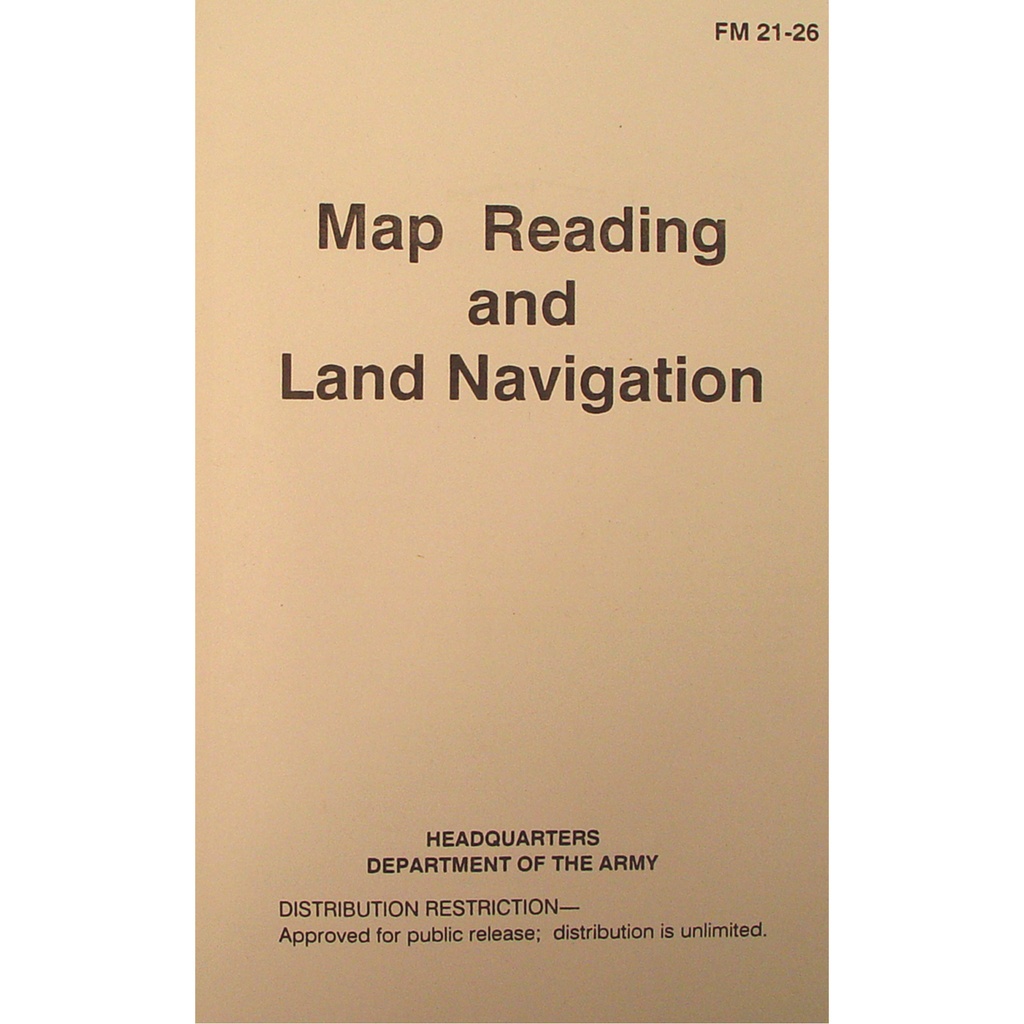
The design is pure military minimalism: ranger-tan cover, black text, official FM identifier, Department of the Army attribution, and the "Approved for public release; distribution is unlimited" line. No graphics, no marketing slogans—just doctrine. That aesthetic alone tells students this is a manual to be highlighted, dog-eared, and carried, not a glossy brochure to skim once.
The perfect-bound softcover holds up to repeated use in classrooms and in the field. It lies open well enough for note-taking and easily tucks into admin pouches, map cases, or the same pack pocket you trust with your best automatic knife.
Legal Context: What You Can Do with This Manual
Unlike an automatic knife or switchblade, there’s no legal gray zone here. This is a reprinted U.S. Army field manual that’s explicitly marked as approved for public release with unlimited distribution. You’re not buying restricted material, controlled tech data, or anything that requires special permissions.
That matters for instructors, agencies, and organizations. You can:
- Issue it to students without legal review headaches
- Use it as your primary or supplementary course text
- Order in bulk for teams, classes, and training rotations
If you’re running a program where automatic knife carry is regulated by state or local law, this manual sidesteps that entire issue. It trains the skill set that works whether students are carrying an OTF, a folder, or nothing but a compass and a map.
What Buyers Ask Before Purchasing an Automatic Knife
Are automatic knives legal?
At the U.S. federal level, automatic knives and switchblades are regulated mostly in terms of interstate commerce and import under the Federal Switchblade Act. That law restricts certain types of automatic knife sales across state lines and into federal jurisdictions, but it does not outright ban possession nationwide. The real complexity is at the state level: some states allow automatic knife carry with few limits, others allow ownership but restrict concealed carry, and a few still heavily restrict switchblades and OTF designs altogether.
Anyone looking to buy an automatic knife for EDC should check their specific state and local laws—what’s legal to carry in one jurisdiction can be a chargeable offense in another. Many serious buyers maintain a small reference of automatic knife legal to carry notes by state or consult reputable knife-rights organizations before deciding on their next piece.
What’s the difference between an automatic knife, OTF, and a switchblade?
Mechanically, an automatic knife is a folder that opens under spring tension when you press a button, slide, or release—no wrist flick or manual opening needed. A classic side-opening automatic swings the blade out from the handle pivot like a traditional folder, just powered by an internal spring.
An OTF (out-the-front) automatic knife is a specific subtype where the blade rides in a track and deploys straight forward out of the handle. Double-action OTF knives both deploy and retract the blade automatically with the same control, while single-action OTFs typically auto-deploy and require manual retraction.
“Switchblade” is a legal and cultural term that, in many statutes, covers both side-opening automatics and OTF knives—any design where a blade opens automatically via a button, switch, or similar device. Collectors and enthusiasts tend to use “automatic knife” and “OTF” for mechanical clarity, and “switchblade” when they’re talking about legal definitions or classic styles.
What makes this automatic knife worth buying?
For a serious buyer, an automatic knife earns its place with three things: a reliable, consistent action; steel that holds an edge instead of just polishing; and a build that doesn’t rattle itself loose after a month of carry. A well-designed automatic should fire cleanly on demand, lock up with minimal play, and use a blade steel heat-treated for real-world cutting, not just spec-sheet bragging rights.
On top of that, the best automatic knife for EDC balances size, clip placement, and in-pocket feel so it actually gets carried. Collectors look for tuned actions, clean grinds, and fitting that shows someone cared during assembly—the same level of attention you’d expect from a well-curated training manual or any other tool you stake performance on.
For Instructors, Collectors, and Serious Gear Users
If you’re the kind of buyer who cares how a double-action automatic locks up or why one OTF runs smoother than another, you already understand why this land navigation manual matters. It’s the doctrinal backbone behind the skills you expect people to have when they step off with a ruck, a compass, and a cutting tool they trust.
Stock it for your next class, hand it to the new team member who needs to close the gap, or add it to the same shelf where you keep your most trusted automatic knives and reference books. Tools fail. Batteries die. Doctrine and skills stay. This manual is where those skills start.