Signal Authority Multiservice Survival Field Manual - Yellow Cover
15 sold in last 24 hours
This isn’t coffee-table survival theory. The Signal Authority Multiservice Survival Field Manual - Yellow Cover is the same doctrine-style SERE reference used to teach survival, evasion, and recovery across Army, Marine Corps, Navy, and Air Force. It breaks down shelters, navigation, signaling, medical, water, and food into clear, field-ready procedures. The signal yellow cover is deliberate: easy to spot in a pack, glovebox, or ruck when everything else is chaos. It’s the manual you carry when you’ve decided guessing isn’t a plan.
Why This Signal Yellow Survival Manual Belongs in a Serious Kit
Gear that earns permanent space in your pack does one thing: it performs when your brain doesn’t. The Signal Authority Multiservice Survival Field Manual - Yellow Cover is built on that premise. It’s a reprint of a true multiservice field manual on survival, evasion, and recovery—written for people who can’t afford to be wrong when the map, plan, or weather goes sideways.
This isn’t some glossy coffee-table “bushcraft tips” book. It’s doctrine. Army, Marine Corps, Navy, and Air Force doctrine, distilled, indexed, and laid out so you can move from panic to process in a few pages.
Multiservice Survival Doctrine, Not Campfire Folklore
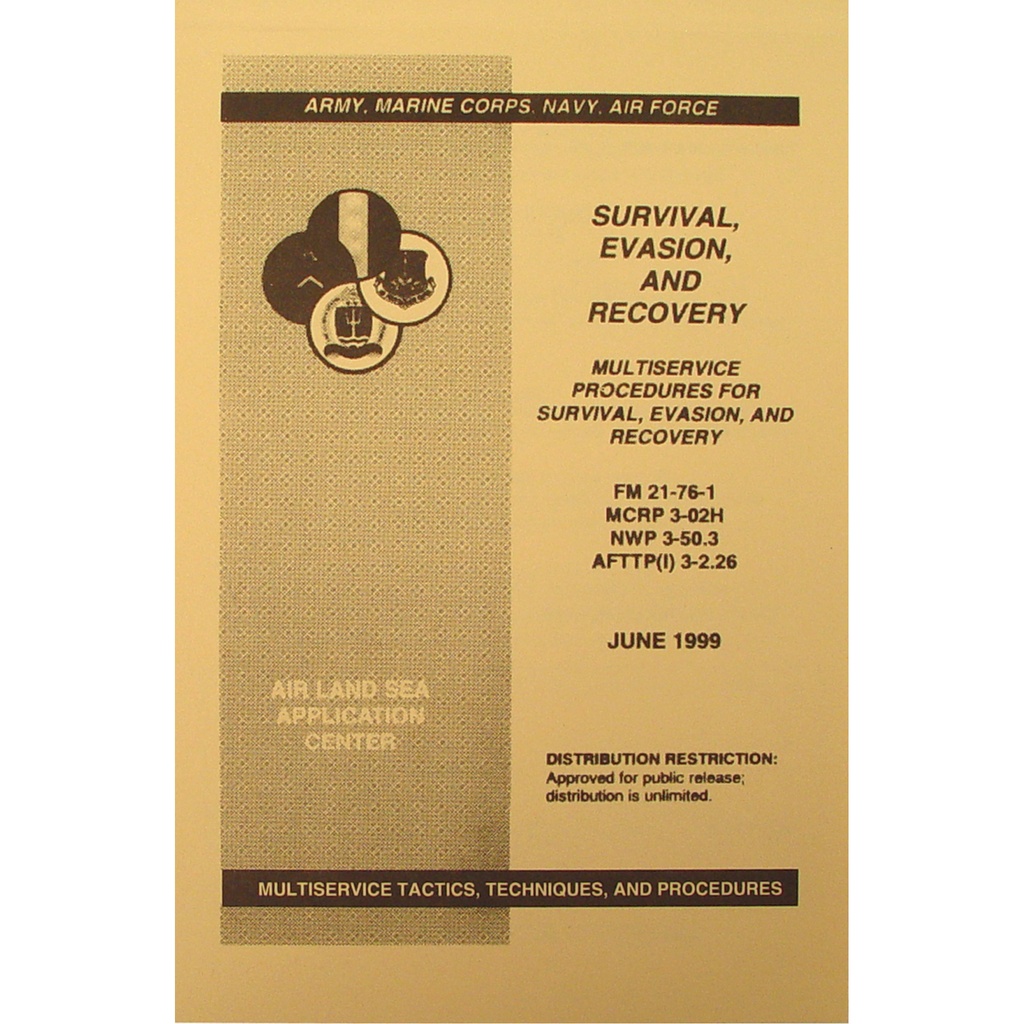
Look at the cover and it tells you exactly what it is: four service emblems, multiservice document codes, and a distribution note. That means the content inside was written, tested, and refined across branches, missions, and real-world constraints. It’s the opposite of influencer survival advice—it’s the playbook the professionals pulled from before social media existed.
The manual covers the full SERE arc: survival, evasion, and recovery. That includes shelters, land navigation without electronics, water sourcing and purification, field-expedient medical, food acquisition, and signaling. The writing is blunt and functional—focused on what you do next, not how you feel about it.
Structured for Stress, Not Leisure Reading
In the field you don’t read cover to cover; you triage. This manual is formatted like a real field reference: clearly separated sections, procedural steps, and diagrams organized so you can jump straight to “how do I build a shelter now?” or “how do I move without being seen?” It’s meant to be flipped open with cold hands and a tired brain, not admired on a shelf.
Signal Yellow: A Design Choice, Not an Aesthetic
The signal yellow cover isn’t cosmetic. It’s the same logic you see in high-vis panels and emergency gear: when your pack is a mess of earth tones and black pouches, you want the one thing that absolutely cannot disappear. In a ruck, in a vehicle, in a closet full of gear, this manual is the easiest thing to find when time is already gone.
How Serious Users Actually Run a Survival Manual
People who take survival seriously treat a manual like a tool, not scripture. You read it before you need it, then carry it when you know your memory might not be enough. This multiservice survival manual fits that workflow.
- Training: Use it as a backbone for classes, unit refreshers, or personal drills. It aligns with military-style SERE framing, so you can build practice around real doctrine.
- Reference: Mark the sections you’re weakest in—navigation, improvised shelters, water—and tab them. Stress-proof your future self.
- Redundancy: Electronics die. Maps get lost. This sits in the glovebox, the larger ruck, the cabin, or the storm shelter as hard-copy redundancy.
Built for Preppers, Instructors, and Real-World Decision Makers
The visual language—service emblems, document numbers, formal layout—signals what this is and who it’s for: people who want procedures that have been tested beyond one YouTube trip. That covers several buyer types:
- Preppers and homesteaders who want a compact, credible survival manual in every main kit.
- Instructors building courses around foundational SERE concepts, needing a common text for students.
- Military-adjacent and first responders who appreciate doctrine-level organization and language.
- Knife and gear enthusiasts who understand that a blade is only as smart as the hand using it—and that means having real reference material close by.
Content Focus: The Core Survival Problem Set
Inside, the manual systematically walks through the survival problem set the same way a good field instructor would:
- Evasion: Movement techniques, concealment principles, and how to avoid making yourself a target when you’re alone, tired, and possibly being hunted.
- Shelters: Practical, scalable shelter options that match terrain, weather, and available materials—built to be executed with minimal tools.
- Navigation: Compass and terrain-based movement, improvised methods when tools fail, and how to keep your heading under fatigue.
- Signaling: Visual, auditory, and improvised methods to be found on your terms, including how and when to signal.
- Medical: Basic field care framed around keeping a casualty—or yourself—alive long enough to matter.
- Water and food: Realistic methods to find, treat, and ration water, plus food acquisition that acknowledges energy cost versus payoff.
Legal and Distribution Context: What That Cover Text Really Means
Along the bottom of the cover you’ll see something most hobby survival books never mention: a distribution statement and an approval for public release. That tells you two things that matter if you care where your information comes from:
- It’s official doctrine-derived material: The content traces back to actual U.S. military publications, not a random compilation.
- It’s cleared for general use: The manual is explicitly approved for public release with unlimited distribution, which means you’re not dealing with gray-area or sensitive material.
This isn’t a legal minefield; it’s a clean, on-the-record survival reference built to be taught, shared, and carried. For instructors and organizations that care about provenance, that’s a quiet but important detail.
What Buyers Ask Before Purchasing an Automatic Knife
Are automatic knives legal?
Under U.S. federal law (per the Switchblade Knife Act), interstate commerce of automatic knives and switchblades is regulated, particularly for importation and shipment across state lines. However, many states have loosened their own restrictions, and some now allow possession and carry of automatic or OTF knives under specific conditions. Others still limit blade length, carry method, or outright ban them. The only answer that respects you is this: check your state and local laws before you buy, before you ship, and before you carry. A reputable dealer will remind you that legality is hyper-local and can change.
What’s the difference between an automatic knife, OTF, and a switchblade?
Knife people draw clear lines. An automatic knife is any knife where the blade is deployed by a button, switch, or similar mechanism and powered open by an internal spring—no thumbstud or manual assist required. A classic side-opening automatic looks like a traditional folding knife that happens to fire open under spring tension. OTF (out-the-front) knives are a subset of automatics where the blade travels linearly out of the front of the handle rather than pivoting from the side; many are double-action, meaning the same control both deploys and retracts the blade. Switchblade is the older legal and cultural term, often used in statutes to describe automatic knives broadly. In enthusiast language, “automatic” is the technical category; “OTF” is a specific mechanism inside it; “switchblade” is the legal catchall you see in older laws.
What makes this automatic knife worth buying?
When you’re evaluating an automatic knife for sale, you’re really judging three things: action, lockup, and steel. A good automatic should fire with authority but without grit or hesitation, lock up with minimal blade play, and use steel that balances hardness with toughness so the edge holds without chipping. Details like coil-spring versus leaf-spring, pivot construction, and overall fit and finish separate serious pieces from novelty. You’re not just buying a blade that opens fast; you’re buying a mechanism you trust not to fail under real pressure.
Why This Manual Belongs Next to Your Best Automatic Knife
If you’re the kind of buyer who cares whether a knife is a single-action OTF, double-action automatic, or traditional side-opener, you already understand that tools are systems, not isolated objects. A precision automatic knife with good steel and tuned action is one part of that system. A legitimate survival manual is another.
The Signal Authority Multiservice Survival Field Manual - Yellow Cover fills the gap between gear and judgment. It gives you procedures when fine motor skills and memory start to fall apart. In a pack full of blades, lights, and fire starters, this is the quiet piece that ties them together—turning hardware into an actual plan.
If you collect automatic knives for EDC, backcountry, or duty use, pair at least one of them with a survival manual that’s earned its place. Gear breaks. Batteries die. Springs wear. A doctrine-grounded, high-visibility field manual like this one is the backup that doesn’t care about charge levels or signal strength—only about your next move when things go sideways.